Search This Blog

Saturday, March 21, 2015

Summer During Winter

It continues to be an unusual winter steelhead season.  Much of the past couple months have been more like summer in my part of the world.  Water levels and weather have been unseasonably mild.  While I love the summer like weather and warmer water temps, I worry about what summer will bring with little to no snowpack in the mountains.  I vision low running streams in the summer and high fire danger.

I haven't "seriously" swung a fly for steelhead for the past couple weeks due to my Honda breaking down as I rounded the last corner before arriving at home from my last trip to the coast.  With a slipping transmission, it was time to grab a used replacement from a local wrecking yard and I ended up spending all of last weekend wrenching on my Honda.

I got out to the North Umpqua today with my friend Craig Coover as we ventured forth to seek our favorite prize.  We decided to fish some water less frequently used by the mob and enjoyed relative solitude in this beautiful place.

Of course with the mild weather, the water temperature was 48 degrees first thing in the morning and was up to 50 by noon.  This could only mean one thing - time to fish a skater for winter steel!!  In fact, I fished a skater with confidence all day.  For most, this would be insanity, but for me, I feel confident of being able to move even winter steelhead when water temps are 48 degrees and above (also noted in Bill McMillian's temperature date).  Some may ask:  "why fish a skater for winter steelhead?"  Instead, I ask "why not fish a skater for winter steelhead?"

I spent some time today fishing my newest color combo on my skater design - "Baby Blue".  I had found some baby blue Globrite floss at a local fly shop and loved the color, but had trouble putting a color blend together to make the floss pop just right.  I finally tried using an orange butt and pink cactus chenielle up front and I think I have a winner!

Unfortunately, I didn't raise a single steelhead today, but these mild conditions will keep me trying!


That seam fished a skater nicely


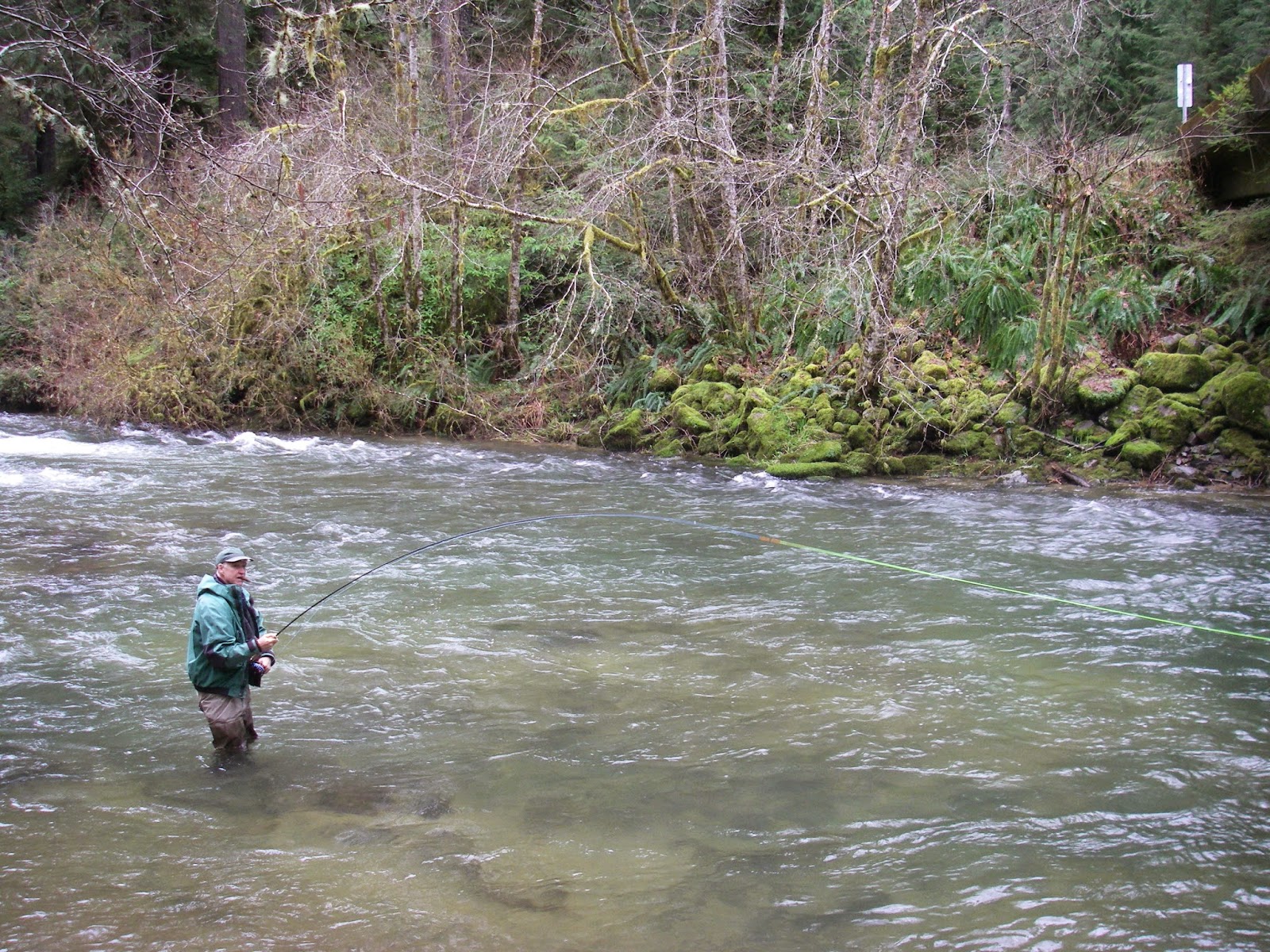
A beautiful day in a beautiful place


My latest skater - "Baby Blue"

Top View


Tuesday, March 10, 2015

The Fishing Car


When I moved back to Oregon in January 2009, I was faced with needing to find a cheap running car that I could use for commuting to work, and of course for the "occasional" trip to the river.  Driving my beloved 74' Bronco with it's big  V-8 engine full time was out of the question with it getting only 10-13 miles per gallon.  As luck would have it, I was able to find a decent 1990 Honda Accord with only 179,000 miles and some custom body damage on the rear quarter panel included for no extra charge.

Custom body work

As a avid home mechanic, I knew those Hondas were fiercely reliable and I was glad to have the title to this functional car.  As it turned out, the transmission began slipping after owning the car for a couple months so it was time to search the local boneyards for a used replacement.  One was quickly found and after a weekend's worth of work, my beater was back in action.  That was back when the car only had about 185,000 miles.

In 2009, I worked in the Albany DHS office so this required an hour commute to work and again at the end of each day as I commuted back home to Springfield.  Along with all the fanatical fishing I was doing, the miles piled on quickly on my little Honda.

My faithful Honda just kept going and going and has been very reliable for the most part.  There was one was one time when it failed me on the river when it would not start.  Luckily I had stopped to visit with my good friend Keith Tymchuck who was fishing one of our favorite runs.  After some quick troubleshooting on the car, I surmised that I must have a bad distributor.  Every car model has an "Achilles Heel" and the distributor is something on those older Hondas that can give out randomly and unexpectedly.

Keith was kind enough to stop his fishing to give me a ride back to town to check the local boneyard for parts.  Luckily, I saw a Honda engine sitting on the floor right when I arrived and was able to purchase the distributor for $60.  Keith drove me back to the river and I popped the new used distributor in it's place and my faithful chariot fired right up.

Another time, a year or so ago, I was happily driving down I-5 when my fuel pump suddenly gave out.  A friend helped me tow my car back to the house and after the back breaking fun of dropping the fuel tank to change out the fuel pump, my fishing car was back on the road.

Any 20+ year old vehicle will end up needing occasional repairs and this is to be expected, but my faithful Honda has overall, kept me stuck in the garage wrenching less often than any vehicle I've ever owned.  It has taken me to the river without fail more times than I can count.  There have been frequent local trips to the Willamette in summer and fall and also regular trips to the North Umpqua during the same time frame.  Winter brings regular trips to the coast for winter steelhead.  Along with my normal haunts, there have been trips to other rivers which have included the Siletz, John Day, Salmon, Santiams, Deschutes, and Siuslaw, among many others.


The result of a run in with a guardrail a couple months ago (headlight replaced)


Along the North Umpqua in July 2013

Frozen car and rods on the John Day in October 2013

Along the Siletz Gorge, August 2010
My faithful Honda has given me so much trouble free service that it has become part of who I am as a fisherman.  My local network of fishing acquaintances readily recognize my car and frequently know where I've been and what I've been up to, depending on where my fishing car is seen.  There have been many fond memories made with trips to rivers near and far in my trusty Honda.  For my friends who have been willing to brave the ride in my smelly, messy, fishing car, there have been many fun trips with great conversations about fishing, family, and life.

I'm not a high maintenance kind of guy, so my Honda, which looks like it has been the victim of many beatings and battles has been the perfect car for me.  It's so ugly and beat up, there's no point in washing it every week, or every year for that matter and it's lack of bling has definitely been a theft deterrent.  Knock on wood, no one has ever attempted to vandalize or break into my chariot because it already looks too run down and beat up for anyone to bother with.  No one would think the owner of such a beater would keep anything of value in it so there would no point going through the trouble of breaking in.

Needless to say, I absolutely love my humble Honda.  However, with 328,000 miles on the clock, I realize that I will either come up against needing an engine/transaxle replacement in the not so distant future, and/or having to consider looking for a suitable replacement car.  I figured since my Honda is a 1990 model, finding a 1992 or 1993 Honda would feel like having a new car!!  But heck, I've heard of folks who have gotten over 400,000 miles on the original engines in these Hondas, with regular oil changes and maintenence, so I may still have more life in this car!

I'm not sure why I'd get so attached to an inanimate object such as a beat up fishing car.  Guess I just have a hard time with change and the thought of my poor Honda going to the salvage yard is a sad thought.

Sometimes things come about which help one in deciding what needs to happen next in a given situation.  This was the case last friday.  I'd had a pleasant afternoon fishing a favorite river on the coast with mild conditions that just begged for fishing a skater the whole time.  This little river is two hours from my home with no cell service.  I've sometimes wondered what I'd do if I ever got stranded along the river with no one around.  I'd have to wait until the odd vehicle came by and then beg a ride from someone to an area where I could call for help.

Anyways, those "what if" thoughts had long since passed through my mind as I was rounding one of the last corners before arriving back at my home.  As I came through a corner, I noted the transmission shifted weird and realized it was due to slippage.  Uh oh.....  I gave a little gas and noted that the engine revved up without the corresponding increase in vehicle speed.  Bad news, my transaxle was slipping and was basically toast.  I was luckily able to make it home and I was so thankful my tranny didn't go out at the river, two hours away, with no cell service.  God was watching over me.

All this means is that it was time to search for another used transaxle to get my Honda back on the road.  I located one in a local wrecking yard for $300 yesterday and I'll have the pleasure of changing my transaxle out this coming Saturday.  I'm hoping to get this job done on Saturday, of course so I can fish on Sunday, but I know my fishing time on Sunday will come at the expense of bruised knuckles and sore arms and shoulders.  Such is the plight of the fly fisher who cannot afford to pay someone to do all their mechanical work.

Wendi finally told me that she thinks it's time to start looking for a new beater after I get my Honda running.  I'll be in the market for another Honda, probably mid to late 90's vintage.  When I someday get a newer car, folks won't recognize my vehicle for a while so I might be able to get away with flying under the radar when I'm out fishing, but I'd still miss my faithful Accord and I'm not sure if I'm ready to give her up!

Saturday, February 21, 2015

Winter Skating

Since my local rivers have dropped and cleared following our big water event earlier in the month, mild, pleasant conditions have prevailed on my recent days astream.  Can't complain of warm, clear days on the river, making for satisfying fishing, despite my inability to get any steelhead slime on my hands yet this season.

With recent water temps ranging 47 degress in the am to 52 degress by midday, I can't help but spend some time skating flies for my local winter runs.  In Dry Line Steelhead, Bill McMillan's data of steelhead activity to the surface in relation to water temps continues to play out in my mind when I get out.  I have a new, reliable stream thermometer, so I've been back to taking water temps first thing in the morning and at midday or in the afternoon.  I'd also take a water temp reading at the time of hooking a fish, whenever that may happen someday.

I got out last monday with it being the President's day holiday.  Great to be a state employee at times...  The water temps were 47 degrees first thing in the morning so I elected to wait until mid day to try skating.  I had skated through a couple runs and by about 2pm, I settled into a little run that was perfect for the skater with good structure, nice soft chop, and perfect depth.  By the time I was near the bottom of the run, I was near to being out to time to fish and having to pack up and leave for home.  I was approaching some overhanging branches that marked the limit of how far I could continue down (I was longing for my pruning saw at that point).

As my big #2 purple/green butt skater came into the upper third of the swing, I was giving it some gentle, pulsating twitches when a surface attack came.  A fish exploded at the fly, but I felt nothing on my end of the line that correlated with the aggressive rise and my heightened level of  sensory awareness.

I went back with comeback attempts without success, but I was overjoyed to have raised what I assume must have been a winter steelhead to the surface.  I say I assumed it was a winter steelhead based on a internal process of elimination:  I did not actually see the fish, but.... there would be no salmon around and the rise was too big of a surface disturbance to be a trout.  The only other possibility was if it was a trophy sized sucker.

I got out again yesterday and the conditions were perfect for skating.  48 degress first thing in the morning, 50 degress by midday.  I skated for most of the day.  The water levels provided many shallow lies that could have held a surface friendly winter steelhead.  But alas, my visions/fantasy were interrupted with reality as no steelhead came up to play.  Still a pleasant day and I will continue to try for the elusive winter surface steelhead attack as conditions allow.

Hopefully folks who actually want to catch steelhead will not follow my crazy example!


Winter Skating

Armed and Ready

JM Reid 8592 Wee Heavy

Skaters En Masse!

This must be a sickness!!

Thursday, February 12, 2015

High Water Cane Clave

It was to be a blissful weekend spent fishing coastal Oregon winter steelhead streams with a couple friends.  The plan was to fish with cane rods the whole weekend, specifically cane rods built by contemporary bamboo rod builder James Reid of Vancouver, BC.  The plan was hatched a couple months ago.  James had contacted me and mentioned that he was coming to Oregon in early February and asked if I would fish with him.  I did not have to give much thought in my response to James - of course I'd take him out to my local water. 

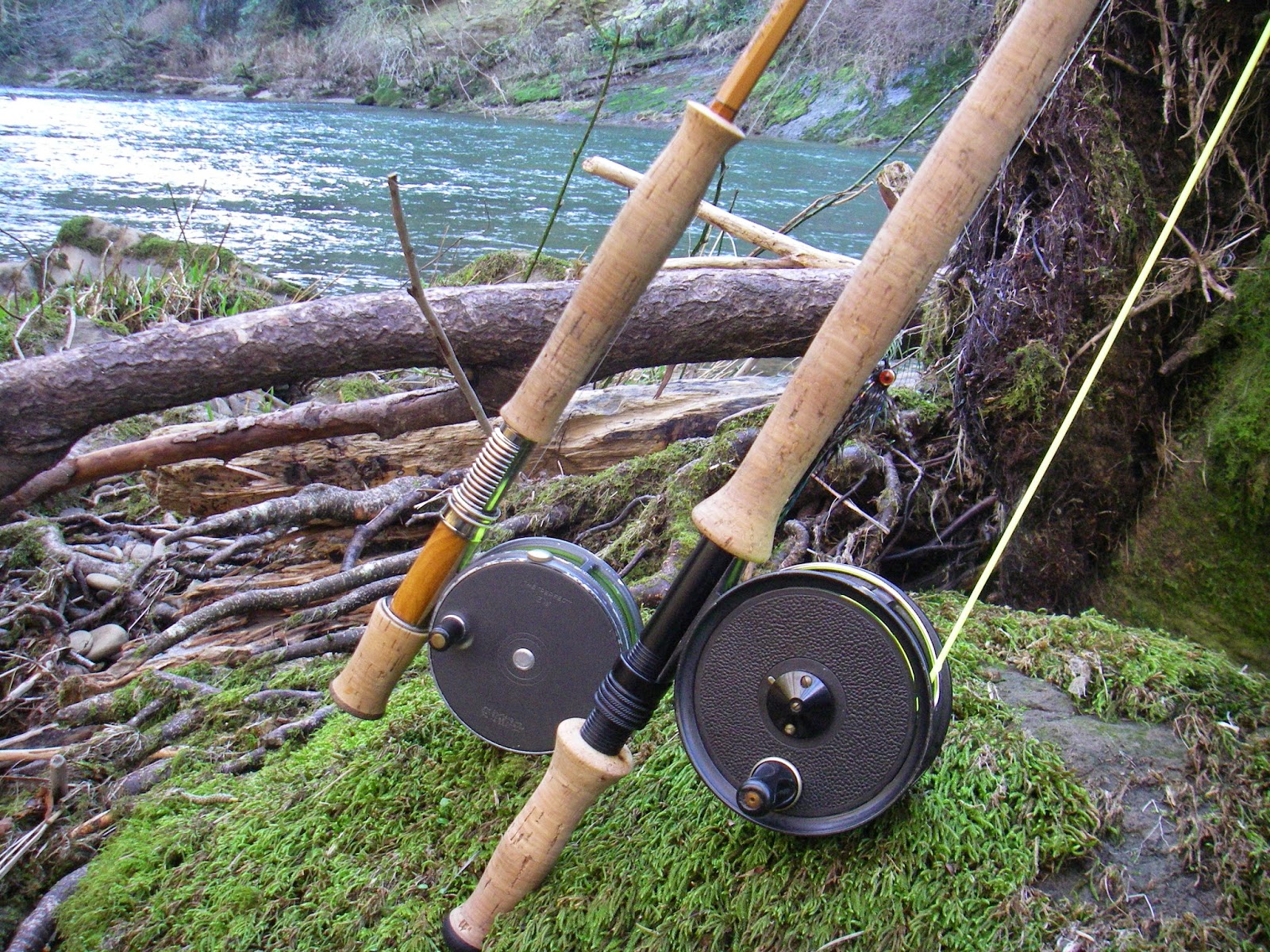
I would also be getting the 8592 "Wee Heavy" - 8'5" 9wt single hand cane prototype back in my hands when James came down.  I had stopped the rod off at James's shop in September on our way up to Skeena country.  James needed to make final inspections of the rod and tweak if necessary.  It turned out the "Wee Heavy" prototype passed James's inspection and had fared well in surviving a hard winter of dry line steelheading while on my watch last year - no tweaking necessary.  As a blue collar steelheader, being able to wield a custom built cane rod is a great luxury and has been an opportunity I never would have had if it weren't for James thinking to build a rod for the kind fishing that I do and inviting me to field test the Wee Heavy last year.

Adrian Cortes would be meeting up with us saturday evening and fishing with us on sunday.  James was also bringing down a replacement tip section for Adrian's 12' 6/7 weight "Summer Run".  Adrian had broken the tip of rod while fishing in December so he was glad to have his beloved cane two hander back in commission.

My dear wife Wendi gave me her blessing to fish saturday and sunday with James (and Adrian on Sunday), in addition to my regular friday fishing day.  Wendi also blessed us with welcoming James and Adrian to spend the night at our home (Wendi and I have been "empty nesters" for the past several months!) along with preparing "Steelhead EnCroute" for dinner on saturday.  I married well!!

As we approached the weekend before James's arrival, I began watching the weather and river level forecasts.  Things were looking good.  Forecasts called for a bit of rain that would bump the rivers just enough to bring them to a good level, then flows would be on the drop during James's weekend of fishing with me.  Anxious emails and texts went back and forth between James and me as we anticipated great conditions with chrome rewards.............

As the week progressed, things started to change.  We realized that weather reports are not written in stone and can be subject to variation, whether we like it or not.  By mid week, more and more rain became part of the weather forecast.  I remained optimistic and undaunted even with the predictions of increased precipitation.  I'm a steelheader afterall - I've got a backup plan - hit smaller flows that still fishes in big water and drops quickly - no problem! 

Closer to the weekend, things started to look grim.  Big rains were coming with the lines on the river forecasts pointing straight up in the coming days.  I still remained optimistic, but started to warn James by text that fishing conditions might be "marginal".  James is no stranger to tough fishing conditions on his homewaters on the lower mainland of BC and Vancouver Island.  I was pleased to hear that he remained game even as we looked at the prospect of fishing a blown river - the question soon became whether we would be able to find any fishable water all!

On the friday before James's arrival, I got out to our smaller ditch with Craig Coover, with river levels already on the rise.  As we descended through the coast range, to our great dismay, we found our ace in the hole high water stream dirty, and growing in size.  Craig looked at the river and made the call to ditch it.  Craig was the one driving and I was along for the ride.  I was then along for the ride home.

When I got home, I checked the river graphs and the forecast called for a slight drop in the levels for Saturday.  Things could work out for James and me after all.

I met up with James in Springfield Saturday morning.  James had made the drive from his friend's home in Portland that morning.  James arrived in his cool 94' Jeep Cherokee that he had modified himself.  James told me of fabricating his own bumpers and roof rack, installing a lift, and boring and stroking the 4.0L inline six.  We briefly traded gear head stories as I also shared about my beloved Classic 74' Bronco with a 351Windsor under the hood.

James talked of monsoon rains all along his journey south from Vancouver, BC and that he felt like he tends to have rain clouds following him whenever he made trips to go after steelhead.  I was reminded of his stories of blown rivers during his prior Skeena trips and started to wonder if he was the cause of all the rain we were getting!  We jumped in my venerable 1990 Honda Accord (only 327,000 miles on this beater) and hit the road.

Upon arriving at the river by mid morning, we were looking at the prospects of fishing what amounted to be a blown river.  Most sane souls would have considered it a lost cause - probably the reason we didn't see any other maniacs out fishing this day.  A running joke came at my expense as James would periodically laugh during his time with me, whenever he would reflect back on my text warning him that river conditions might be "marginal".

Marginal??  

Look Fishable??


So much potential here

I admired and respected James for remaining steadfast, even in the grim conditions we were faced with.  We both have the inclination to "make the best of things" even when we were looking upon a high, dirty stream, with our only option to eek out any bit of soft, inside water we could find.

We hit some of my usual spots and we were surprised and glad that we were actually able to find a few inside cushions of soft water to fish.  When we had initially stopped to look at the water James was ecstatic as he looked into the brown flow and exclaimed "we've got a foot of visibility"!

A foot of vis??

We both adapted to the tough conditions by squeezing into tight spots with brush at our backs and often times, branches overhead.  Creative casts were in order and I think we each may have even invented a few new casts.  James only fell in once when he stepped off an unseen ledge that he couldn't see in the colored water.

Watch for the ledge James!
The Winter's Hope - one of about three fly patterns I know how to tie

The 8592 Wee Heavy felt at home in my hands again and it performed flawlessly in the impossible places I was casting from.  It's firm, crisp action, along with the short, heavy 350 grain Ambush line made this tough game a lot easier.  I readily fell back into the rhythm of casting and fishing this fine piece of steelhead equipment.

On top of it all, it was so cool to be fishing my home water with the guy who built my one and only cane rod.  James and I fell into a comfortable pace with our fishing and I commented to him that I somehow felt like I'd been fishing with him for a long time.  Our levels of determination, tempered with realistic expectations under the adverse conditions, were in sync during our time together.

We even decided to explore some water I'd never fished before and I was pleased that we found a couple more nice swing spots to add to my quiver.  Sometimes it takes having a guy from out of town to get me to think outside of the box and learn new stuff even on my homewater.

James and I actually managed to find enough soft inside water along the flooded river to make a full day out if it.   The isolated places where steelhead could conceivably be holding actually gave us some confidence that we could find a resting chromer somewhere in the compressed zones we were fishing.

Despite our best efforts, we found no willing players.  By late afternoon, we called it a day, satisfied and content that we successfully fished as well as we could in the near impossible conditions we were faced with.  There is a certain joy in being able to take conditions as they are and doing better than just making the best things.

We met up with Adrian back in town and John Sherman of Corvallis also came down to join in for dinner at the house.   John is the owner of one of Jame's custom made bamboo switch rods that he had James make for Oregon coastal winter steelhead.  A tweaker had stolen the extra tip section of John's rod from his rig, so James made a replacement and brought it down for John.

The four of us enjoyed the wonderful dinner that my dear wife prepared for us and we stayed up visiting until about 2am.  We would have just enough time to get a bit of sleep before our 6am wake call for the start of another day of Oregon winter steelheading.

The rain had briefly slowed while river levels crested and a slight drop was predicted for our day on the water.  Upon arriving at the scene of yesterday's crimes, we found the river had dropped about a foot, with visibility of about 2 feet, a great improvement over the day before.  Don't get me wrong, the river was still running high, but compared to the prior day, conditions looked perfect.  Of course, levels were still much too high for sane people and we had the place to ourselves.  Can't complain of having solitude while showing off my homewater to my friends.

James was fishing his newest salt water companion rod that he just built for a bonefish trip he was taking to my former homestate of Hawaii in a couple weeks.  With this companion rod, he is able to fish it as a 8'9" 8wt single hander and with the longer butt section, it fishes as a switch rod.  With the short casts we often needed on the swollen river, James fished the single hand configuration both days.

To the promised land
James fishing his bonefish rod while Adrian looks on with anticipation.

Adrian was happy to have his 12' 6/7wt "Summer Run" back in commission and he fished it throughout the day.  He was able to work his longer rod in the tight spots pretty well and he was firing off tight loops as well as ever as he fished his classic irons on a dry line.

I continued fishing my 8'5" 9wt "Wee Heavy" throughout the day and even James commented on how well that rod fished my coastal winter steelhead haunt.  It was the perfect tool for the job at hand.

At the first pool we fished, I actually spooked a little buck of about 5lbs out of a nearshore side channel that I typically traipse through without giving a thought.  This little colored buck simply glided over to the adjoining larger side channel and James actually tried swinging his fly to where we thought the steelhead settled to but James's fly remained untouched. 

Perfect conditions - cane magic by James Reid

Adrian working his "Summer Run" for winter steel with a dry line and classic flies
We fished through runs that we covered the day before and manged to find yet another new pool that swung our flies nicely.  At one of the pools that had produced mutiple steelhead for my buddy Craig last year, I had James and Adrian fishing the upper and lower sections of this water while I took a break from fishing and was able to scan the water from a higher vantage point.  As I looked into the lower section of the pool, I recalled the little buck I saw earlier in the day that was sitting literally right next to the bank.  Accordingly, I focused on the nearshore water that I could see into and lo and behold, I spotted what looked like a bright steelhead of about 12lbs in a nearshore slot on river left in a spot that seemed impossible to swing a fly to.

I alerted James and Adrian of what I saw and James decided to try for the fish with a skater while I watched from above and helped guide his swings.  James tied one of my foam skaters to the tippet section on my Wee Heavy and gave it a go.  Adrian and I watched anxiously as we found that James was actually able to get the skater over the lie.  James was able to make multiple swings in front of the steelhead, but it wasn't a taker, even in the balmy 52 degree water.  As it turned out, the surface fly was the only presentation that could have been put over the fish without hanging up.
James fishing a skater to the steelhead spotted in the slot near the bank, see it??  Photo by Adrian Cortes

We ended the day fishing through the same pool where we started the day.  My pet steelhead was not in the shore side channel but the river had continued to drop over the course of the day.  The run fished beautifully for the three steelhead fanatics waving beautifully built cane rods that were created by a true contemporary master - James Reid.  It was akin to an art aficionado being able to hang out with the master artist himself, pretty cool stuff and quite a privilege.

The drive back to town went by quickly despite our sleep deprivation and lack of steelhead hookups.  Excited talk about our favorite fish, cane rods, and places we've fished and wanted to fish flowed easily.  Our plans for our next BC trip in the fall was discussed and tentative plans to meet up with James again, possibly at the beginning or tail ends of our travel through BC were contemplated.  James offered Adrian and I the opportunity to taste of his homewaters and we spoke longingly of intimate waters with free rising summer steelhead - images that were kindled by steelhead literature I had read.

On arriving back in Springfield, we unloaded my trusty Honda and celebrated over having a wonderful day of doing what we love.   Adrian and I would be getting back to daily life and James was headed back towards Portland with plans to fish the Sandy River the following day with mutual friend and guide extraordinaire Marty Sheppard.  (I later found out that James got a beautiful chromer during his day with Marty)  James harvested a handful of skaters from my box to share with Marty and Mia Sheppard as a token gift from the dry line steelheader in Springfield.  I bid the guys farewell for the time being, and left with the great satisfaction that comes from fishing with wonderful like-minded friends in the beauty of God's Creation.


Sunday, January 18, 2015

The Reproductive Ecology of Oncorhynchus mykiss in Tributary Streams of the Mid Skagit River Basin


Bill McMillan generously shared the documents below on his ongoing study of the Mid-Skagit tributaries.  Bill has tirelessly conducted spawning surveys on these tributaries and he has collected, graphed, and interpreted this data through scientific methods.  Of note is the presence of hatchery steelhead on the spawning grounds in these tributaries and also significant spawning activity before the supposed March 15 timeline of supposed wild steelhead spawning commencement.  My hope is that the evidence in this study will be a harbinger of further wild steelhead recovery on the Skagit with the complete cessation of hatchery plants.  

Kudos and much gratitude to Bill for his dedicated study of wild steelhead on the Skagit, and beyond, and for his immeasurable contributions to wild steelhead conservation.

Links to the documents provided below and I've copied over the summary of Bill's draft.

--------------------

McMillan, B. 2015. The Reproductive Ecology of Oncorhynchus mykiss in Tributary Streams of the Mid Skagit River Basin.
The information provided is pertinent to the present public process related to the Draft Environmental Impact Statement (DEIS) on Two Joint State and Tribal Resource Management Plans for Puget Sound Salmon and Steelhead Hatchery Programs.  Some of those who provide comments to the DEIS will be citing this Summary (and the report it represents).  
The 2010-2014 Mid Skagit tributary spawning surveys were independently done by me as a retired field biologist (Wild Fish Conservancy for 10 years) motivated by both a personal and scientific interest of living on the Mid Skagit River in order to fill a temporal void in steelhead spawning information that I knew existed.  There was no funding provided by anyone.  This void in steelhead spawning information has long existed in much of Western Washington and has resulted in much misunderstanding about the life histories of wild winter-run steelhead and their sharing of spawning habitat with feral Chambers Creek hatchery steelhead. 

https://www.academia.edu/10197391/Reproductive_Ecology_of_O._mykiss_in_Tributary_Streams_of_Mid_Skagit_River_Basin_Final_Summary_1-16-2015


The Reproductive Ecology of Oncorhynchus mykiss
in Tributary Streams of the Mid Skagit River Basin
(A Final Summary with the full report still in Draft form)
 

Bill McMillan
(January 15, 2015)
40104 Savage Road
Concrete, WA 98237


Acknowledgments:  In great appreciation for the several reviews and helpful comments provided by George Pess of NOAA’s Northwest Fisheries Science Center in the drafting of the Summary and the full report it represents; to Nora Kammer of Skagit River System Cooperative tribes for Savage Creek pond observations; and to Brett Barkdull of Washington Department of Fish and Wildlife for a 2014 Skagit basin steelhead spawning escapement estimate.


Summary


From October of 2009 to June of 2014 regular spawning surveys were independently and voluntarily made for personal fishery interests as a retired field biologist at five Mid Skagit basin tributary streams that support the spawning of the anadromous life history of Oncorhynchus mykiss (O. mykiss) commonly known as steelhead.  The most intensive of these five years of surveys were those from October 2013 to June of 2014 with a total of 125 spawning surveys made at these five tributaries.  Puget Sound Steelhead in Washington are listed under the Endangered Species Act (ESA) as Threatened, including those of the Skagit River basin.  Several and perhaps all of the same tributaries also support resident O. mykiss populations commonly known as rainbow trout.  All of the same tributaries also have spawning populations of coho salmon (O. kisutch) and pink salmon (O. gorbuscha) as well as coastal cutthroat trout (O. clarki clarki) of both anadromous and resident life histories.  Four of the streams also have spawning chum salmon (O. keta) and three have spawning returns of ESA listed Chinook salmon (O. tshawytscha). 

Winter steelhead spawning surveys in the Skagit basin by Washington Department of Fish and Wildlife (WDFW) have targeted an initiation time of March 15th in the supposition that is when wild steelhead begin to spawn.  In fact, management of winter steelhead has been based on the belief that hatchery steelhead spawn prior to March 15th and wild after with little potential for spawning interactions between the two to occur.  However, no recent history was found of steelhead spawning surveys that regularly occurred prior to March 15th from which to justify this conclusion in the Skagit basin.  Historic evidence from the early 1900s indicates Skagit basin winter steelhead began to spawn by early February and Mid Skagit tributary entry for spawning began by January.  On the Northwest Coast of Washington where spawning surveys were initiated in January by Washington Department of Natural Resources (WDNR) from 1973 to 1980, and similarly so during independent surveys by the Wild Salmon Center (WSC) from 1999 to 2003, it was found that wild winter steelhead spawning begins by early January.  Other areas of the Pacific Northwest also exhibit early steelhead spawning. For instance, the State of Oregon’s spawning survey protocol for coastal rivers is from mid-January through mid-May.  In British Columbia wild winter steelhead spawning historically began as early as January on central Vancouver Island and in more recent history by January or February at least as far north as the Queen Charlotte Islands and Southeast Alaska.  

The 2009-10 to 2013-14 spawning surveys at the five Mid Skagit tributaries were initiated with the first fall storms that stimulate the upstream migration of anadromous spawning runs.  This was to insure that no steelhead spawning was missed and to determine what the overlaps between steelhead spawning time with other salmonids may be.  Over the five years the
earliest steelhead spawning redd found was January 16th and the latest June 6th.  Coho salmon and steelhead were found to have slight overlapping spawning times some years but it was
typically minimal.   Sea-run and resident cutthroat were found to have significant spawning time overlaps with steelhead.  Hatchery steelhead were included in the O. mykiss spawning population mix and steelhead mating (both wild and feral hatchery) included wild resident male life histories.  

There were 104 total steelhead redds counted in the five years of Mid Skagit tributary surveys (Table 1).  Almost half (49%) of the redds were found prior to March 15th, the assumed initiation date of wild steelhead spawning.  Over half (53%) of the steelhead were estimated to have spawned prior to March 15th when redd sightings were adjusted for spawn timing (Figure 1).  In the five years of surveys a total of 18 O. mykiss (14 steelhead, 2 male residents, and 2 undetermined male steelhead or residents) were observed at 7 active spawning redds between January and June (Table 2).  The hatchery proportion of the steelhead in the spawning mix was 40%.  If the wild male resident life history was included it decreased to 33% hatchery.  Both wild and hatchery origin steelhead were found spawning in the early time period of January to mid March.  The hatchery proportion of the steelhead spawning mix prior to March 15th was 67% (Table 3).  If the wild male resident life history was included it decreased to 50% hatchery. Although no hatchery steelhead were found spawning after March 15th the unknown origin steelhead after that date were 20% of the total steelhead observed.  Of particular concern, hatchery steelhead were found spawning to the maximum upstream anadromous extent of the smallest tributaries in the Mid Skagit basin.   

The spawning time of steelhead was found to vary between tributaries. Over 50% of the spawning occurred prior to March 15th in three of the tributaries. The two other tributaries had 50% of the spawning occurring after March 15th.  Air/water temperature, precipitation, streamflow, and intermittent or perennial hydrology were all examined as potential explanations for the spawn timing differences.  Streamflow hydrology best explained the steelhead spawn timing differences. Specifically, whether a tributary’s hydrology was intermittent or perennial was found to be a particularly probable driver regarding whether most steelhead spawned prior to March 15th or most thereafter (Figure 3).  This was hypothesized to be due to the need for spawning to be early enough for significant numbers of emergent steelhead fry to move either downstream to perennial waters prior to late June to early July when intermittent flows began to disconnect these tributaries from larger downstream water bodies, or upstream if that option were available. Although intermittency is predicted to increase in northward expansion with climate change, and is sometimes perceived as a great limitation on steelhead reproductive success, there are examples of high steelhead productivity that occurs in intermittent streams and where gravel accumulations may actually provide better spawning habitat if steelhead life histories have effectively adapted with early spawning and emergence.

From the limited specific tributary water temperatures taken, the coldest stream had the latest steelhead spawn timing and the four warmer streams earlier. At the cumulative level of all five tributaries a highly significant correlation was found between average monthly air temperature and steelhead redds per month when adjusted to spawning date if 50-67% of the redds during the early spawning period were eliminated to better reflect wild steelhead spawning (Figure 2). Spawn timing also varied by year. In one tributary with significant spawners in 2010 and 2014 the warmer year (2010) had a month earlier spawning peak than the colder year (2014).  Active spawning was found to most commonly occur shortly after a flow peak on a falling hydrograph at all tributaries and on cloudy days and/or at late afternoon to evening.

Underwater photographs found and confirmed that steelhead fry emergence occurred by late May at one of the intermittent tributaries and at another with side channels going intermittent by May.  Steelhead fry were likely present dating to at least mid May but they could not be clearly identified in the photographs.  It is important to note that photographs were not taken prior to mid May which might have captured even earlier emergence. 

The one stream attribute identified that resulted in more intensive steelhead spawning was that of a well contained channel with least difference between wetted and bankfull widths (bankfull width/wetted width ratio) during the steelhead spawning period.  This was found to be the case at the entire length of the one stream with the greatest steelhead redds/km, and at one particularly heavily used side channel of a stream that otherwise had a broad and actively moving mainstem channel.

Shifts in the monthly pattern of air temperatures and precipitation since 1909 (Tables 4 and 5) were examined as were relevant streamflows dating to 1928 (Table 6).  Shifts are occurring that are particularly correlated with the steelhead spawning period of January to May.  Air temperature trends include warmer air temperatures in January, less variable temperatures in February, and cooler temperatures in the remaining months. More precipitation now occurs in each of the months except February, as well as greater average streamflow, with the exception of February and May.  Historically peak spring streamflow occurred in May, now peak spring streamflow occurs in March. Steelhead spawn timing must adapt to these climate related changes.  It is important to note that the one month with least change is February.  It may provide an important temporal point of climatic stability for steelhead spawning that has remained little changed the past 100 years. 

For historic comparison, three of the five Mid Skagit tributaries regularly surveyed in 2014 were also surveyed in 1978-1981.  The steelhead redds/km found in 2014 were 35%-78% of that in the earlier time period (Table 7).  Mid Skagit tributaries are now apparently much less productive for wild steelhead than was the case about 35 years ago.  This may not necessarily be explained by habitat loss and/or ocean conditions alone.  It may be at least as significantly related to loss of steelhead life histories (such as early run-timing and/or early spawning) that can no longer fill formerly productive and widespread habitat that is increasingly left depleted or vacated.  At that earlier time, the smaller tributaries were found to support 65-80% of all steelhead spawning in the Skagit basin despite an average escapement estimate of 5,700 wild steelhead, over 63% less than the preliminary escapement estimate of over 9,000 in 2014 (Table 8).  If tributaries were at former productivity levels, presumably the 2014 wild steelhead return would have been greater than it was.  Identifying and resolving the present limitations for tributary steelhead productivity in the Skagit basin may lead to considerable wild steelhead recovery progress. 

The 67% of hatchery steelhead found spawning in Mid Skagit tributaries prior to March 15th was of particular concern that would be anticipated to be most problematic for wild O. mykiss populations (that include both anadromous and resident life histories) at tributaries typified by warmer winter flows and/or intermittent hydrology.  Four of the five tributaries regularly surveyed had these characteristics.  Regarding future genetic studies that may occur, it will be important to recognize the early period of time when steelhead spawning can occur in Skagit basin tributary streams with subsequent early fry emergence.  To indicatively represent the hatchery signal sampling should occur that includes the earliest fry stage prior to significant depletion through natural selection from early May to mid June.  After that time increasingly high depletion of hatchery and hybrid fry whose life histories may well exclude effective movements from intermittent streams or stream sections would be anticipated.  In general, hatchery heritage would be anticipated to result in increased fry/parr loss over time due to greater vulnerability to predation, or due to other factors that commonly limit hatchery related characteristics to survive as well as wild.  The least effective time to find a hatchery genetic signal would be anticipated in juvenile sampling occurring from July onward, and least of all from returning adult steelhead.

These independent 2010-2014 Mid Skagit tributary surveys provide a baseline for the
full period of steelhead spawning that has otherwise been lacking from which to monitor wild steelhead escapements, the hatchery component of the escapements, and how the steelhead spawning is variable in time and quantity by individual tributaries that have similarly variable characteristics that need to be understood.  Recovery planning can be anticipated to be more effective if it is based on information that effectively represents the reproductive ecology of wild O. mykiss populations that include both anadromous and resident life histories.  This can occur with further refinement of this spawning survey and reproductive evaluation template that includes habitat differences along with the differing adaptive life history strategies of the fish themselves. 

Saturday, January 10, 2015

Winter Musings

It's been a somewhat strange winter season for me thus far.  We had coho salmon lingering in our local rivers until late December with several caught by friends while swinging for steel.  There has been enough rain to bring fresh fish in the rivers, but it seems things are running late.  My friend Keith Tymchuck got a couple in December, but December was overall pretty slow and January has overall, yielded slow fishing thus far as well.  There are exceptions, such as Craig Coover having a three fish day this past week and another story I heard of another friend finding multiple fish one day the week before.  Just gotta be in the right place in the right time. 

I've been going through my normal winter dry line swinging routine and my overall results are a few grabs that seemed like steelhead and a brief hookup in a tailout that was probably a small steelhead.  None of my normal dry line runs have produced that electrifying chrome encounter that I need so badly.

Yesterday, I fished with good friends Adrian Cortes, Steve Turner, and Craig Coover on a favorite winter river.  With the dry weather, we had a mild winter day with a river that had been on a slow drop for the past week or so. 

In anticipation of the low flows, a good friend was gracious enough to gift me with a beautiful Orange Heron to swing with my dry line in the softer, shallower lies I would be experiencing.  This fly looked so nice in the water that I could not imagine how it could go without getting grabbed.  As expected, this fly fished beautifully in the gentle glides that the low water provided.  I fished this beautiful fly with the utmost confidence over the course of the day and alas, no chrome attack was forthcoming.

In a favored locale, Craig breifly hooked a nice buck that got off after some headshakes and a jump and he had a couple more subtle pulls, most likely of the chome kind, as we continued to work down through the run.

At another spot Adrain got a good solid yank on his snow fly, but no hookup.  Craig followed up and got a pull in the same area.

Steve spent most of the day taking photos and enjoying time on a river new to him while mixing in just a little bit of fishing in.

I had a great time with my good friends and I enjoyed the pleasant rhythm of swinging with the dry line in what I felt was optimum conditions for my chosen method. 

Continued persistence is the name of the game for me as I continue through the winter season.

A fishy guy in his element

Possibilities

Beautiful freestyle fly gifted by Tony Torrence

Thursday, January 1, 2015

Steelhead Paradise in Swing the Fly

The newest issue of the awesome online fly fishing mag Swing the Fly is live:

http://www.joomag.com/magazine/swing-the-fly-issue-23-winter-2014-15/0453762001415824776?short

I'm honored and thrilled that editor Zack Williams caught wind of the collaborative story that Steve Turner, Adrian Cortes, and I put together of our wonderful  BC trip and decided to publish an edited version in the current issue of Swing the Fly.  It is a surreal experience to be in the company of all the notable contributors and great stories featured.