With all the fun I was having experiencing surface steelhead into early December, I just couldn't get myself to stop fishing on top, even as winter steelhead season was definitely upon us.
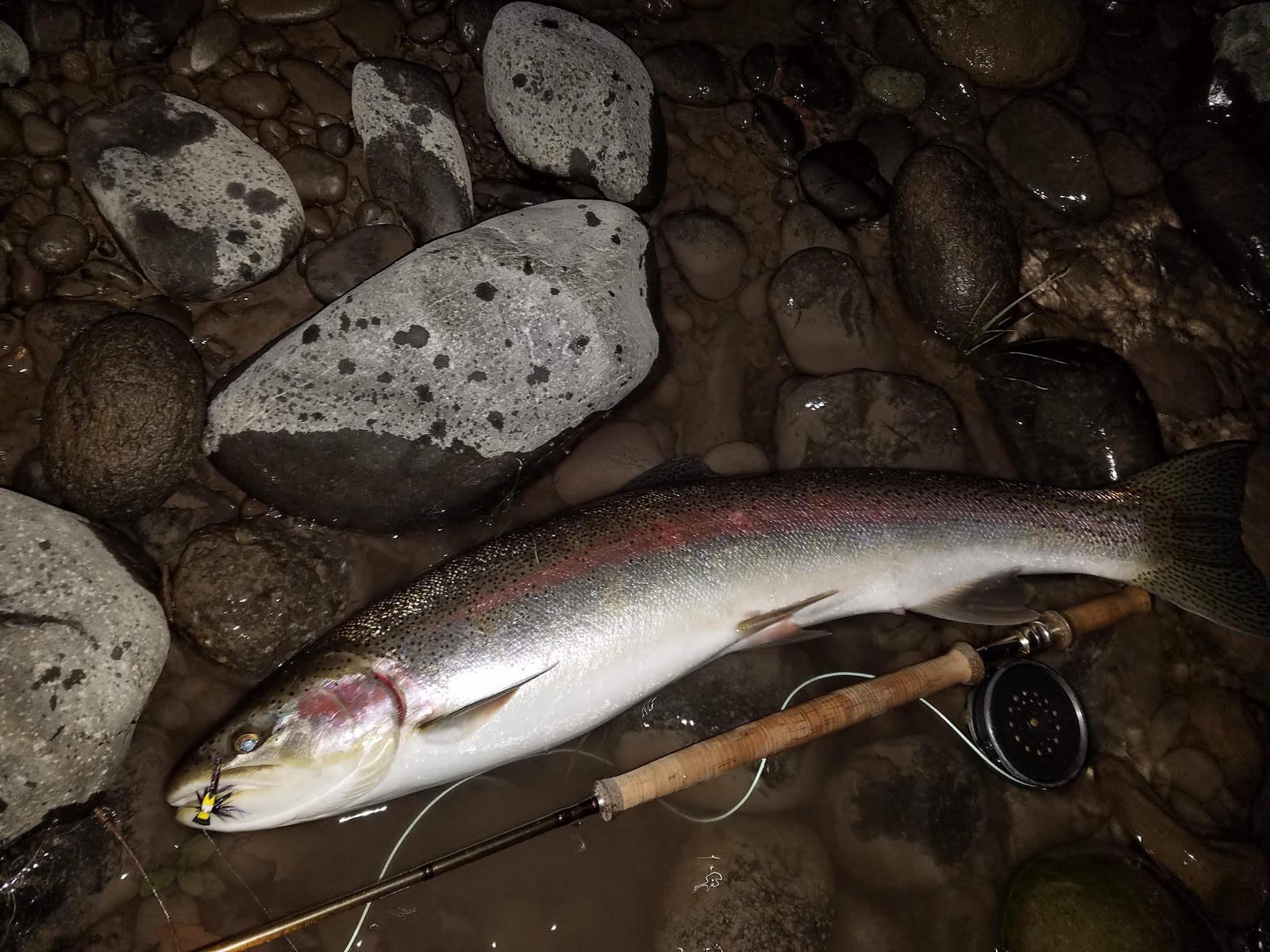
It was a chilly 38 degree morning on December 14, 2018, but my homewater was still running at summer levels so I stayed with my summer gear and summer approach with a surface fly. I started at the top of a favorite run and I was pleasantly surprised with a sudden aggressive rise to my green-butt yellow stimuwaker. The steelhead was instantly hooked and taking off on it's first run. I was anticipating that I hooked into another late hatchery summer run, but this steelhead seemed to fight with more determination than I'd expect from a tired hatchery brat. As the steelhead drew closer I was able to see that it was not a large fish but that it seemed quite bright. I was then determined to land this steelhead so I could get a better look. I wondered if it might even be late running wild steelhead.
I fought the steelhead carefully, but with steady pressure. I was eventually able to lead the steelhead into a shallow bay. It was a bright hatchery hen in perfect form. I took a few photos and rejoiced in the blessing of getting a second dry fly steelhead in December. Water temperature was 44 degrees.
I later emailed a picture of the steelhead and the story of it's capture to Bill McMillan. Bill responded that he felt like the steelhead looked like a winter run which must have strayed up my way possibly from the Clackamas. At the time of encountering this steelhead, there were 3 non-finclipped winter steelhead counted that ascended Willamette falls. Catching this steelhead on a dry fly was definitely like finding a needle in a massive haystack!
On December 30, 2018 I found myself on river that is better known for it's hatchery winter steelhead run and parades of sidedrifters that pursue them. This is not among the popular winter steelhead fly swinging rivers, but as an extra opportunity to fish coincided with my better half's plans, I went for it.
I drove into a little town along the river and managed to find some river access up and down from a popular boat launch. The water above the boat launch looked and fished well, but it was no surprise that I didn't find a steelhead that was willing to rise in the 44 degree water that was also showing some color.
I made my way to the water downstream of the boat launch and noted it to be running fairly briskly as it came out of the rapids below a long pool. As I surveyed this run, I saw that there were two rocky outcrops on my bank that broke up the current and formed soft cushions downstream as the current evened out. I fished the first bay and felt that it swung my surface fly nicely, providing a miniture flat where a winter steelhead would have a break from the main flow.
I felt a fair amount of confidence and anticipation, even in this unlikely location and under atypical surface steelhead conditions. There was a high water event the week before and the river was on a steady drop, so at least I had that on my side.
That first piece of water below the rock break didn't produce any excitement so I proceeded down to the second outcrop to swing through the soft water below.
I had just recently purchased a 11' 3wt Vector trout spey that was on sale from my local Cabelas and balaced with a 200gr OPST Commando head and 50gr 10' floating trout tip. I was enjoying casting my purple and black Bivisiwang with this light setup.
I remembered that there are folks who are concerned with overplaying and tiring steelhead out with such a light rod. I knew that as long as I was staying with my typical 8# or 10# maxima for tippet, that I would still be able to fight steelhead aggressively with a low rod position and clamping down on my click/pawl reel.
As I settled into fishing the flows below that second break, I noted that the rock structure extended diagonally underwater towards mid river. This made for cover and soft cushions where steelhead could hold. As I fished through this juicy stuff I was imagining what it would be like to put the light rod to the test with a legit winter steelhead pulling on the other end.
I made a cast across the break formed by the diagonal rock structure and as my Bivisiwang came past the bump of current, I suddenly saw the boadside form of a steelhead launching itself across the surface as it took my fly. My line drew tight and the fight was on.
My chance to confirm my ability to quickly land a winter steelhead on a light trout spey presented itself quicker than expected! I lowered the rod as I tightened into the steelhead with my little 3 5/8 Perfect. The steelhead made several short but powerful runs, but I kept as much preesure as possible on the reel to slow and tire the steelhead without breaking the 10# maxima tippet.
Within about 5 minutes, I had the steelhead near shore in a convenient shallow area. I was able to get a few photos while noticing that the steelhead was still very strong and fresh.
Getting 3 steelhead on surface flies in December has never happened to me before. This has given me enough encouragement to fish on the surface full time through the rest of winter and beyond! I hope to have more dry fly winter steelhead stories to tell in the coming weeks.
A Fishing Life Inspired by the Writings, Methods, and Conservation Work of Bill McMillan
Search This Blog
Friday, February 8, 2019
Sunday, December 9, 2018
December Dry Fly Steelhead
![]() |
| Dry Fly Steelhead in December, a first! Photo by Todd Hirano |
By this time, I generally stop fishing my homewater as winter rainstorms typically keep the middle fork Willamette running high and dirty. This year has been an unusual exception. Dry conditions have allowed my local ditch to stay at summer levels, so of course, I have continued to fish it with summer methods, despite the cooler water. Obviously, I am not always in touch with reality, but it's too late to change.
On this day (Sunday, December 9, 2018), I was able to negotiate an extra day of fishing since my normal friday fishing day was cut short. To make appearances of being a decent husband, I came home early from fishing on Friday to drag the brand new 500lb hot tub my wife purchased from the garage where it was delivered, to the back of the house where project management wanted it. I felt like I earned some extra credit.
I elected to hit a coastal drainage in pursuit of winter steelhead like normal people do. I fished hard from about 8:30am til about 2pm. I readily got back into the flow of swinging my favorite Winter's Hopes on a full floating Beaulah Aerohead cast with my vintage Sage 7136. I had an enjoyable time fishing through the overcast and light drizzles through the day.
By early afternoon, I had not received any chrome feedback so my mind wandered towards heading back towards home and trying for one last dry fly steelhead for the year on my homewater. At the end of the last run, my line drew tight and the lively pulse of a fish was felt. Just as I thought that my plans to head homeward was being joyfully interrupted, I realized that my fishy encounter was smaller in scale than hoped for. I stripped in the scrappy fighter and found it to be a perfect male cutthroat of about 15 inches. A respectable prize, but when a guy's mind runs on one track, expectations can become distorted.
After releasing the hardy cutthroat, my focus returned to getting in some time on familiar runs close to home. I made the drive back through overcast and intermittent drizzles. As I rounded the bend to a favorite run, I noticed a drift boat with gear fisherman anchored low in the water that I typically fish through. I wondered "what could those guys be thinking fishing here today?" Then I thought of what those gear guys might be thinking about a fly angler fishing through there in hopes of getting a steelhead on a surface fly today..
I figured to start fishing at the top of the run in spite the unexpected company on this unlikely day. As I set up and began walking to the top of the run, the gear guys pulled anchor and of course, they also fished through the lower run that I intended to fish as well. I guess solitude is not a guarantee, even when one might assume folks would be focussing their attention elsewhere so late in the season.
I fished through until my swings were overlapping the area where my gear chucking friends were achored. With less than 30 minutes left before dark, I left for the lower run, never mind that the gear boat just fished through. I was fishing the my usual foam waker with a couple tweaks: two forward facing indicator posts - one black and one white, tied on a #4 gamakatsu octopus hook.
![]() |
| Purple and Black "Bivisiwang" tied on #4 Gamakatsu Octopus hook. Photo by Todd Hirano |
The third cast to this fish went out cleanly as my vintage Sage 7136 and Beaulah Aerohead did their job in executing a smooth double spey. I twitched my waker through the swing and in the familiar location, the same rise came, this time followed by solid resistance. I instinctively swept the rod towards the bank and came tight to something that was definitely more substantial than the cutthroat I hooked a couple hours ago. The creature fought doggedly and powerfully. It had enough authority to be immovable at times, but it eventually succumbed to steady side pressure and when it came closer to the bank, I was able to positively identify it as a steelhead. I was eventually able to pull the steelhead to the bank and contained it by kneeling down in the river to keep the steelhead between me and the bank as I took photos. (Water temp: 45.3 degrees)
What a unique surface steelhead season it has been! I have gotten steelhead on the surface every month since May. I am truly blessed by God beyond mere existence, but blessed in exuberant abundance!
![]() |
| Bivisiwang cannot be seen as it is hooked in the tongue of this December Buck. Tying my waker on the Gami Octopus hook proves to hold steelhead solidly. Todd Hirano photo. |
Monday, November 12, 2018
The Best Laid Plans
![]() |
| A Peaceful Place. Photo by Todd Hirano |
Sometimes the best laid plans take unexpected turns. After recently surviving a week in Disneyworld, I was anxious to get back into the swing of things. As the weekend neared, another roadtrip was schemed. Plans included meeting up with a new friend made through social media (Surface Steelhead tends to bring fanatics together). This kind fellow recently discovered the thrills of surface steelhead and he was offering to show me around his homewater, a difficult offer to refuse. As the weekend approached, I was reminded of an appointment on my end which had me leaving town at midday rather than at the pre butt crack of dawn. It also turned out that my new friend had prior commitments that he had forgotten about so this became a solo venture.
I hit the road, but as I got a ways into my multi hour drive, traffic became an issue as well. Thoughts of arriving on the river by mid afternoon were reduced to the possibility of getting to a run just before dusk. With the traffic delays, I thought of just getting settled in for the evening and setting my sights on fishing the following day, but the voices in my head never stop, saying things like "you might as well drive up there anyway, get the lay of the land, maybe even wet a line if there is a bit of daylight left". Upon arrival at the river, it turned out that I was left with about a half hour of daylight to select a run to fish on a river I had only once briefly fished in 1997. I had no real memory of the layout of this river so I was largely dependent on intel messaged from my new friend.
In the dimming light, I managed to scope a run that seemed to look fishable, but I had no sense of it's possibilities. I was not even sure I had arrived in an area my new friend had described. I quickly fished a riffle leading into a bend pool and found as supected, that the flow quickly eddied out due to swirls formed by the inside of the bend. I reeled up and surveyed the flows upstream.
With light quickly fading, I jumped in my rig made a quick run a couple hundred yards upstream. There appeared to be a narrow run with the main flow pushing along the far side. The upper section seemed fast so I fished through quickly until I arrived in the lower half of the run. The river widened and the flow spread out. I was barely able to discern that there was good depth until the bottom began to rise near shore. I saw some potential with this water but I felt the urgency of my time running out.
As I hurriedly fished down, I could periodically make out the white foam post on my fly. At dusk with my fly no longer visible, I heard a splash near the end of a swing followed by a pull. I was barely able to make out the surface disturbance in the near darkness. After a second, it registered that I had encountered a steelhead, but I also know that often, when a steelhead feels unusual resistance from a tiny object waking in the surface, suspicions are raised and the game is over. Never mind logic, another cast was made and in the same nearshore locale, another surface splash was heard and barely seen, followed by another firm pull. My fly continued to the dangle as my system tensed with excitement and anxiety over whether this steelhead's second unusual encounter with a unmovable purple and black bug would have surely taught a cautionary lesson about going after weird flies. The next cast went unanswered by Mr. Steelhead and I thought that my chances for a hookup went down the tubes. I pondered my next move and figured a fly change would be difficult at best in the near darkness, so I decided to shorten up my cast by one strip, or about 3 feet. The next cast went out with diminished hopes, but as my notorious foam fly swung from the deeper main flow towards the nearshore rise, the steelhead came back with another splashy rise, followed by a firm pull, but this time, what followed was a screaming 3 5/8" Perfect.
The steelhead took off on a series of runs and I initially thought it was a typical sized fish, but when it seemed to be able to do whatever it wanted, I realized it might be above average in size. At one point the steelhead came toward me and my line totally went slack. As I was recovering line, I resigned to feeling the sting of a lost fish, then the line suddenly came tight again and the fight resumed. Consistent side pressure with my 10'6" 5wt switch ultimately got this beautiful steelhead to hand.
I was in awe at the sight of the broad shoulders and length of this steelhead that was larger than those that I normally encounter. I was extremely happy to find success in such a small window in unlikely circumstances. Some days, I am surpremely blessed by these kinds of incidents and never take them for granted!
(I had fished the river the following day at a more leisurely pace with no success but had a chance to take water temperature readings. My thermometer read 44 degrees in the morning and 45 degrees in early afternoon. This was a warmer day than the day before, so the steelhead encounter described above would have occurred in water temperature no warmer than 45 degrees, considered relatively cool for surface fishing. Sometimes steelhead like to break rules and persistence with the surface fly pays off.)
Tuesday, October 23, 2018
The Player
![]() |
| Solo camp. Todd Hirano photo |
Now, being in the middle of fall and looking back on my road games, I have recalled perhaps raising a couple steelhead to the surface and very briefly feeling a pull on one of those rises. I also hooked and lost what appeared to be a small one salt steelhead/large half pounder that I mistook as a trout so mostly stripped in until the hook pulled out. All this amounts to a dismal record for all the hours driven and gas burned in my crazy pursuit of dry fly steelhead.
In spite of my poor road game record, I recently decided to make the multi-hour drive to one of those fall dry fly friendly rivers that flow east of Portland and west of Montana. It was to be a solo overnight trip which would involve putting more miles on my faithful Geo Tracker (286,000+miles on the odometer and a leaking front crankshaft oil seal) and the risk of freezing my gonads off while sleeping on my cot in my thin walled tent. The weather forecast only called for lows in the 40s at night so I hoped to have a chance at staying toasty as a marshmallow as I slept
Upon my arrival in mid afternoon, the day was warm and bright so I decided to leisurely set up camp and ate a late lunch consisting of a tuna sandwich, crackers, pepperoni and cheese (non keto, right?). I then wadered up and pondered my game plan for the afternoon/eve. Three runs are near camp so I would start at one where I found success before and then hit the others.
The first run fished well, but no steelhead made their appearance on the surface. I fished the second run, again with no excitement provided by the steelhead. By the time I finished fishing the second run, there was still ample daylight remaining. I thought of taking a second pass through the run to fill the remaining 45 minutes of daylight in my typical never give up, diehard style, then I remembered that in my rushed packing routine, I forgot to bring my headlamp and lantern. I decided to go back to camp, eat more of the same junk food for dinner and then get situated for bed before darkness set in.
With the short days of fall, I had a long, lonely night ahead. I turned in early and decided to trust the walls of my tent to protect me against any cougars, bears, or psycho deer or elk that might want to harass a lone Asian. Sleeping on a cot is nicer than sleeping on the ground, but it is still not the same as my bed at home. I tossed and turned, periodically woke up and checked my watch. All the while I kept thinking it felt cold for being in the 40s. I also noted weird noises being made by critters outside during the night, but I tried not to think too much of what was causing them. Hopefully, the racket was being made by harmless birds or overactive trolls, rather than some apex predator plotting my demise.
Morning came and I found that I didn't feel as rested as expected, probably due to the cold and freaky noises I tried not to think too much about. When I rolled out of the tent, I realized why the night seemed cold for being forecast to be in the 40s. My waders were frozen solid as they were perched from the roof rack of the Geo and the Geo's windows were frosted over.
Since there was no point in rushing to the river under the frozen conditions, I leisurely broke camp and ate more junk food for breakfast. In the meantime, I pried my waders off the roof rack and let them thaw while I blasted the Geo's heater on them.
When my Simms G3s thawed enough to be manipulated without breaking into pieces, I got suited up and realized that I forgot my winter gloves and cap at home as well. Obviously, I have not gotten fully into the cold weather fishing drill after months of tropical fishing conditions.
I did my best to stay warm with all the layers that I brought, along with my hoodie and rain shell as a windbreaker. My first steps across a little side channel allowed my boot laces and gravel guards to fully thaw out so I was able to fully synch myself together as I walked to my campwater run.
This run is classically configured, with a nice head and broadening seam. I felt like a steelhead could be holding anywhere from the very top, down to where the current began to tank. I got into an easy rhythm as the quiet morning allowed smooth cack handed single speys with my lightweight Cabelas 10'6" 5wt switch and my newest favorite 3 5/8 Hardy Perfect. The 330grain Rage head flew out with tight loops as it pulled out 10 strips of 25lb slickshooter with a satisfying jerk at the reel arbor at the end my better casts.
By the time I reached the bottom of the run, I realized that no steelhead interrupted the bliss I was experiencing as I exercised my favorite equipment and latest version of my foam waker. I pulled out my thermometer to take a water temperature reading, as if that would explain my ineffectual effort. The thermo read 51 degrees, after the freezing night, not surprisingly, down from yesterday afternoon's 57 degrees. Of course 51 degrees is still ideal for surface steelhead activity so maybe no steelhead were in the run or they weren't awake yet.
I arrived on the second run which is one where I have encountered surface steelhead in the past. I started in the faster water leading into the head of the run so my swings would be covering the uppermost corner or "armpit" of the run.
As I began to get past the armpit and into the upper seam of the run, I remember feeling discouraged and thinking I would probably be chalking up another empty roadtrip to my season record. I then prayed for a steelhead rise to my green butt yellow stimuwaker. As I contemplated feeling guilty in praying for something I wanted as a selfish indulgence rather praying for something of noble need, I noticed a surface disturbance in the periphery of my daydreaming gaze. Before I fully realized what happened, the steelhead made another lunge at my fly as it swung through the seam along the main current.
My selfish prayer was promptly answered, proving that sometimes God even answers prayers of the self-absorbed! I stayed calm and allowed my fly to settle into the soft water near the bank at the end of it's swing. I made the same cast and the steelhead came back with a playful rise, clearly short of the fly. I made another cast with no results.
I worried about the possibility of not bringing this steelhead back to the surface so I decided to take my time in tying on a different fly for a comeback presentation. My new friend Adam Snyder had just gifted me with some Lambroughton style wakers so I tied one on with a Garoutte hitch. I made the cast and watched for the fly on the swing. I could not spot the fly and realized it was being pulled under the surface. When the swing was completed, I stripped the fly in and applied some paste floatant to it. On the next cast the moose haired waker was still being pulled under so a change was in order.
A size 10 purple and black wang was knotted on for the next comeback attempt. The little fly was quickly spotted when it splashed down in the main flow. As the tiny waker came through it's swing into the near seam, a head appeared making a "slurpee" kind of rise, missing the fly. The subsequent cast brought a similar rise and miss of the fly. The cast after that brought no response.
By now, my system is in overload with excitement while also dealing with the anxiety of whether I would get this steelhead on the hook or be given the cold shoulder after being strung along for this cruel, crazy ride.
Next on the docket was a size 10 Royal Green wang that I normally use for trout skating. I tried shortening up, in case my steelhead moved into the armpit of the run after all the commotion I was causing. Nothing happened until I was back to casting with 8 strips of running line behind the Rage head. The steelhead came back to the surface in the same place and nosed at the trout sized offering, again missing the fly. The repeat cast brought a boil behind the fly along the inside edge of the seam. The next two presentations drew blanks and I feared that my window of opportunity was closing.
I remained hopeful and the only thing I could think of doing at that point was to tie on the original fly that drew that steelhead to the surface to begin with. The green butt yellow stimuwaker (GBYS) went back on the line along with another selfish prayer. The fly landed on the far side of the main flow and came across broadside as I gently twitched it along during it's swing.
As the bright posted circus on a hook came into the danger zone it was aggressively intercepted by a "big gulp". I soon felt tension on the line and I responded with a smooth lift of my rod. The steelhead took off on a run then made a short jump and thrashed on the surface. A few more runs followed and my little Perfect did its job of recovering line and slowing the steelhead down as I applied pressure to the spool face.
I eventually brought the modestly sized wild hen near the bank as I tailed it in the shallow water. I was filled with joy and gratitude as I gazed down at the answer to my selfish prayers and exclaimed to myself - God is good!
![]() |
| This player made for my first victory on the road for 2018. Todd Hirano photo |
I love every surface steelhead encounter I am blessed to experience, but those players that keep coming back through multiple fly changes until getting hooked are among the most memorable. The suspense that builds as one strategizes through the excitement of getting a series of comeback rises make my connections with players the highlights of my dry fly steelhead seasons.
![]() |
| Evidence of the comeback routine. Todd Hirano photo Green Butt Yellow Stimuwaker opens and closes the deal. Todd Hirano photo |
Thursday, October 18, 2018
Dry Line Dedication
Steelhead fly fishing, especially with a swung fly on a "dry" or floating line, is an endeavor of self-imposed restraints. It is where one leaves behind the efficiency and effectiveness of other methods in exchange for an experience that is often more challenging, yet for some, more deeply meaningful and rewarding. The sudden attack to a surface fly in summer and fall and the unseen pull to a deeply swung wet fly in winter are what fuels my passion and provide images that stream through my consciousness throughout the year
.
Ever since reading the book Dry Line Steelhead by Bill McMillan in the early 90s, I have evolved into an angler who pursues steelhead exclusively with a floating line. Staying with the floating line throughout the warmer months is common with many anglers. However, I may have taken the teaching of Dry Line Steelhead to the extreme, where I am virtually unwavering with fishing surface flies from May through November. I also fish surface flies a fair amount during the winter steelhead season, especially during March and April and at times when winter conditions are mild and with moderate water levels. The thrill of steelhead takes on the surface is so imprinted in my brain, that I willingly forgo other methods while staying with the surface fly, even when the odds are stacked against such behavior.
Surface fishing for steelhead is a highly visual method. Just the process of tracking my surface fly during the swing is mesmerizing and satisfying. I found when fishing patterns that were either difficult to see or that didn't stay on the surface consistently defeated the purpose of fishing on top for me. Over time, I experimented with surface patterns until I arrived at a pattern of my own design that satisfied my needs for visibility and consistent waking. My fly was a merging of Dean Finnerty's skater, Tony Wratney's Foam Dome, the Yellow Stimulator, and Mark Pinch's Riffle Dancer. The resulting fly was highly visible, stayed on the surface consistently, and eventually, found approval from aggressive steelhead. Early prototypes were gifted to friends Adrian Cortes and Steve Turner. In turn, Steve Turner showed my flies to steelhead guide Jeff Hickman. Jeff's first response to seeing the strange fly was "this thing looks like it has a little wang" and the name of my fly was born, for better or for worse.
Fishing the floating line throughout the winter steelhead season can be a most difficult proposition. The colder water and more volatile conditions brought on during winter can leave one seriously questioning the rationale of making a tough game even tougher. Staying with a floating line, long mono leader and flies tied on large/heavy hooks (like the Winter's Hope) or other lightly weighted patterns can seem like an exercise in futility during winter. However, by being selective of water types one chooses to fish, success with the dry line can be attained. I tend to look for soft inside cushions that allows the fly to sink and stay reasonably deep during the swing.
Fishing the dry line swing during winter means one is knowingly choosing to utilize a method that further reduces a fly fisherman's effectiveness. It is a self-imposed restraint that will leave one in a position of being outfished by nymphers and those eqeuipped with sink tip systems. However, when that hard earned pull comes from an unseen chrome creature in the depths, all sacrifices will be worthwhile and the reward will be sweet with a great sense of accomplishment through beating the odds.
Dedication to the dry line has led me to examine my own motives and what I have realized is that going after numbers of steelhead is never the point. What I value most from pursing such a magnificent gamefish is finding joy in utilizing Dry Line methods where my patience, persistence, faith, and tenacity are put to the test. In my opinion, Dry Line methods bring out the steelhead's best qualities - that savage attack to a surface fly and the solid pull to a deeply sunk fly show off their aggressive nature and strength.
.
Ever since reading the book Dry Line Steelhead by Bill McMillan in the early 90s, I have evolved into an angler who pursues steelhead exclusively with a floating line. Staying with the floating line throughout the warmer months is common with many anglers. However, I may have taken the teaching of Dry Line Steelhead to the extreme, where I am virtually unwavering with fishing surface flies from May through November. I also fish surface flies a fair amount during the winter steelhead season, especially during March and April and at times when winter conditions are mild and with moderate water levels. The thrill of steelhead takes on the surface is so imprinted in my brain, that I willingly forgo other methods while staying with the surface fly, even when the odds are stacked against such behavior.
![]() |
| Steelhead taken on the surface |
Surface fishing for steelhead is a highly visual method. Just the process of tracking my surface fly during the swing is mesmerizing and satisfying. I found when fishing patterns that were either difficult to see or that didn't stay on the surface consistently defeated the purpose of fishing on top for me. Over time, I experimented with surface patterns until I arrived at a pattern of my own design that satisfied my needs for visibility and consistent waking. My fly was a merging of Dean Finnerty's skater, Tony Wratney's Foam Dome, the Yellow Stimulator, and Mark Pinch's Riffle Dancer. The resulting fly was highly visible, stayed on the surface consistently, and eventually, found approval from aggressive steelhead. Early prototypes were gifted to friends Adrian Cortes and Steve Turner. In turn, Steve Turner showed my flies to steelhead guide Jeff Hickman. Jeff's first response to seeing the strange fly was "this thing looks like it has a little wang" and the name of my fly was born, for better or for worse.
| Little Wang |
Fishing the floating line throughout the winter steelhead season can be a most difficult proposition. The colder water and more volatile conditions brought on during winter can leave one seriously questioning the rationale of making a tough game even tougher. Staying with a floating line, long mono leader and flies tied on large/heavy hooks (like the Winter's Hope) or other lightly weighted patterns can seem like an exercise in futility during winter. However, by being selective of water types one chooses to fish, success with the dry line can be attained. I tend to look for soft inside cushions that allows the fly to sink and stay reasonably deep during the swing.
Fishing the dry line swing during winter means one is knowingly choosing to utilize a method that further reduces a fly fisherman's effectiveness. It is a self-imposed restraint that will leave one in a position of being outfished by nymphers and those eqeuipped with sink tip systems. However, when that hard earned pull comes from an unseen chrome creature in the depths, all sacrifices will be worthwhile and the reward will be sweet with a great sense of accomplishment through beating the odds.
| Fresh Winter Steelhead taken on a floating line and 5/0 Winters's Hope
|
Tuesday, April 24, 2018
The Journey To Surface Steelhead Obsession - Inspirations by Bill McMillan
| Promising Steelhead Water. Photo by Todd Hirano |
You arrive at the final pool of the day as dusk approaches. The river's brilliance overwhelms you in the glow of this mid September evening. You've fished this pool many times and it has been the most consistent producer of steelhead rises for you over the course of time that you have fished this famous summer steelhead river. As you approach the lower part of the run, you recognize the subtle break in the current that marks the hold where steelhead rises have come in the past. You are comfortable in a nice casting rhythm where your skater is consistently reaching and swinging through the zone.
Your anticipation is high and when you reach the point where your skater swings over the familiar dimple of current, it happens: a large explosion of water overtakes your fly and unbelievably, you feel nothing except a sudden rush of adrenaline. You manage to keep your cool and allow the skater to continue swinging as you maintain a subtle twitch on the fly. As your skater continues to swing a few more feet, another eruption at your fly occurs as it approaches the dangle. Again, you are in total disbelief that your fly is not lodged in the mouth of the chrome attacker. You allow the skater to settle to the dangle just in case a take might occur on the hang down. After a few seconds go by, you are satisfied that the steelhead has returned to it's lie.
You take a breath to allow your nerves to settle and then you strip in as you prepare for your next cast. You pray that you can maintain your calm to be be able to make another clean delivery back to the zone. The reverse snap T goes out briskly and turns over nicely in the dimming evening light. The skater swings through the grid and again, a large rise occurs at the fly in the same location, yet there is no tactile indication following the violent encounter. Likewise, the follow up lunge comes a second later and your skater bobs back to the surface and continues through the swing, unscathed. By now your nerves are a tangled mess as you can't imagine how it is possible that you have not connected with the majestic creature after those massive, aggressive attacks at your fly.
You tell yourself to pull it together as you gather your senses and make your next cast, again praying for a clean turnover. As hoped, the reverse snap T goes out with the loop of line unfolding nicely over the evening flow and the skater is back over the lie. A couple seconds into the swing the fly suddenly disappears in a massive rise that somehow seems even more definitive than those that preceded it and then all !@#$% breaks loose. The line comes tight in an instant and your reel is making a high pitched scream. The next thing you know, backing is flying out through the guides of your little vintage 8' 7wt glass rod. It seems like the steelhead will not be stopping anytime soon and just when it appears that it will be breaking over into the pool below, the steelhead stops and allows you to slowly gather the backing and running line. You get part of the Ambush head back in the guides and then the steelhead takes off on another blistering run as hot and long as the first one. The steelhead again appears to stop just short of the break and you manage to methodically regain your backing and most the the fly line. The steelhead briefly holds out from you then it takes off on a third, shorter run. You sense the steelhead tiring and as you slowly gain ground on this powerful prize, the bright glow of the steelhead can be seen, not 10-15 feet off the bank. You feel a sense of awe and fear as you catch a glimpse of what appears to be a large, bright hen steelhead in the mid teens range.
This is a steelhead much larger than you are typically used to seeing and you are in sensory overload as you take it all in. The movements of the steelhead start to slow and you begin to feel like you might actually have a chance of landing the beast. Just as you begin visualizing how you will bring this steelhead to hand, it makes a quick flip and turns. As you brace for another run, your skater pulls out of the mouth of the grand fish. The sting of disappointment comes over you, but you somehow start laughing as you find humor in the irony in losing something you wanted so badly. All you can do is pause as time seems to be standing still and you realize you can feel your heart beating in your chest. Finally, you gather yourself and look up at the grandeur of this beautiful place set against the evening sky. As you gaze up at the heavens, you are taken by feeling an overwhelming sense of gratitude for being so blessed to experience such an incredible thrill that gives all meaning to your life as an angler.
| The quest for surface steel tends to draw me to beautiful places. Todd Hirano photo |
I've been under the grip of surface steelheading for the past twenty eight years or so. My fascination with steelhead dry fly fishing started when I began reading Bill McMillan's famous book Dry Line Steelhead in the late 80's/early 90's and when I viewed footage of steelhead taking surface flies in Lani Waller's famous 3M videos. Watching Lani Waller skate up steelhead on the Dean and Babine got me excited about trying for steelhead on the surface, but it was Bill McMillan, through his writing in Dry Line Steelhead that gave a much deeper meaning to pursing steelhead with surface methods.
Just as my early interest in surface steelheading began to peak, my family and I moved from Oregon back to my childhood home of Kauai, Hawaii in July 1990 and we remained in Hawaii until 2009, with a brief move to Bozeman, Montana from 1993-1994. This meant a nearly twenty year time frame living far away from steelhead country with at most two trips per year in pursuit of steelhead.
| Desert steelhead that took my skater in a large broadside rise. Todd Hirano photo |
During that initial trip to BC, my readings of Dry Line Steelhead replayed in my mind and gave me confidence through my unsure beginnings in trying to get steelhead on the surface. I was able to manage not ripping the fly away when steelhead would suddenly appear with a massive explosion to my waking fly and I persisted with the surface fly even during spells involving many unanswered casts and swings.
![]() |
| Misty Morning on a BC river where surface steelhead await. |
I mustered up the courage to write to Bill, care of Amato Publications, to thank him for the inspiration he had provided me through his writing and to share stories of my initial surface steelhead experiences in BC. To my surprise, I received a letter back from Bill about two weeks later! I was impressed by the humble and unassuming words of a man that I look up to and so dearly respect. There was not even a hint of any kind of celebrity tone in Bill's letter. It was evident that Bill took the time to write a thoughtful response full of encouragement and appreciation. Bill's warmth and kindness came through in that letter, which made my regard for him run even deeper.
In subsequent steelhead trips from my former Hawaii home to BC, Oregon, and Washington, I still persisted with the surface fly even in spite of those trips being infrequent and involving long distance travel and financial expense. I managed to get into several more steelhead on surface flies during those long distance trips to steelhead country, but I was occasionally questioned about my sanity with remaining committed to a generally lower percentage method under circumstances where most normal folks would want to maximize their chances of encountering the chrome prize. The only possible answer to such questions........obsession.
I returned to live in Oregon in 2009 when our family settled in Springfield. Just prior to moving back to Oregon, I was able to re-establish contact with Bill and we have regularly stayed in touch. We have become good friends and I feel ever so blessed to have a connection with my surface steelheading mentor. We have communications about steelhead conservation issues and of course we also share stories about surface fishing for steelhed. It is so great to see and hear from Bill today, the same level of excitement about steelhead rises, just as he conveyed back in the day when he wrote his famous articles on the subject. My friends Adrian Cortes, Steve Turner and I have also been able to visit Bill at his home for the past few years as we travel north to BC each fall. Our visits with Bill are always enriching and memorable, where a few hours can pass by as we thoroughly enjoy Bill's company.
![]() |
| My Mentor and Steelheading Icon. Photo by Steve Turner |
![]() |
| Bill McMillan in his study that he refers to as the "Inner Sanctum" Photo By Steve Turner |
Over the years, I have communicated the thrills of surface steelheading through some of my posts on fly fishing forums like Spey Pages, on my blog "Dry Line Steelhead - Oregon", and of course through conversations with my fishing friends and acquaintances. There seems to be a rising interest is surface steelheading in recent years which has been so great to see as I have felt like a lone ranger in the past with my unusual commitment to fishing surface flies. I was accustomed to getting puzzled or even unbelieving looks from fellow steelheaders as I talked of the thrills I was experiencing with bringing steelhead to the surface. At other times, I have even gotten some angry responses or been accused of feeling "superior" when I have spoken of my surface steelhead passion. I am glad that in the current steelheading culture, with surface steelheading being more in the mainstream, I am more frequently seen as a harmless eccentric who is just stubborn and single-minded.
Since my early experiences with the thrills of surface steelhead, I find it difficult to fish subsurface if there is even remote chance that I could bring a steelhead to the top. My reasoning is that one's chances of getting a steelhead on the surface are greatly reduced if one is fishing a wet fly. This may sound snobbish to some, but it is just a matter of a guy doing what he likes, never mind that being more versatile will result in more steelhead encounters. Another bit of my skewed logic: Many people adapt their methods to suit prevailing conditions, but I prevail until conditions suit my method. Another question to ponder: Would you rather experience the subtle hesitation of a strike indicator or the surface explosion to a waker??
I also realize that experiencing some success with getting steelhead on surface methods doesn't push every one over the top like it has with me. I actually know of people who have experienced some surface steelhead success, think it's great, then happily go back to fishing wets/tips if the fishing is slow or if they just feel like it. Of course there's nothing wrong with that, but in my mind I may be thinking things like "what do you mean you are giving up on the waker, the river's not frozen over yet and there's at least 6 inches of vis".
![]() |
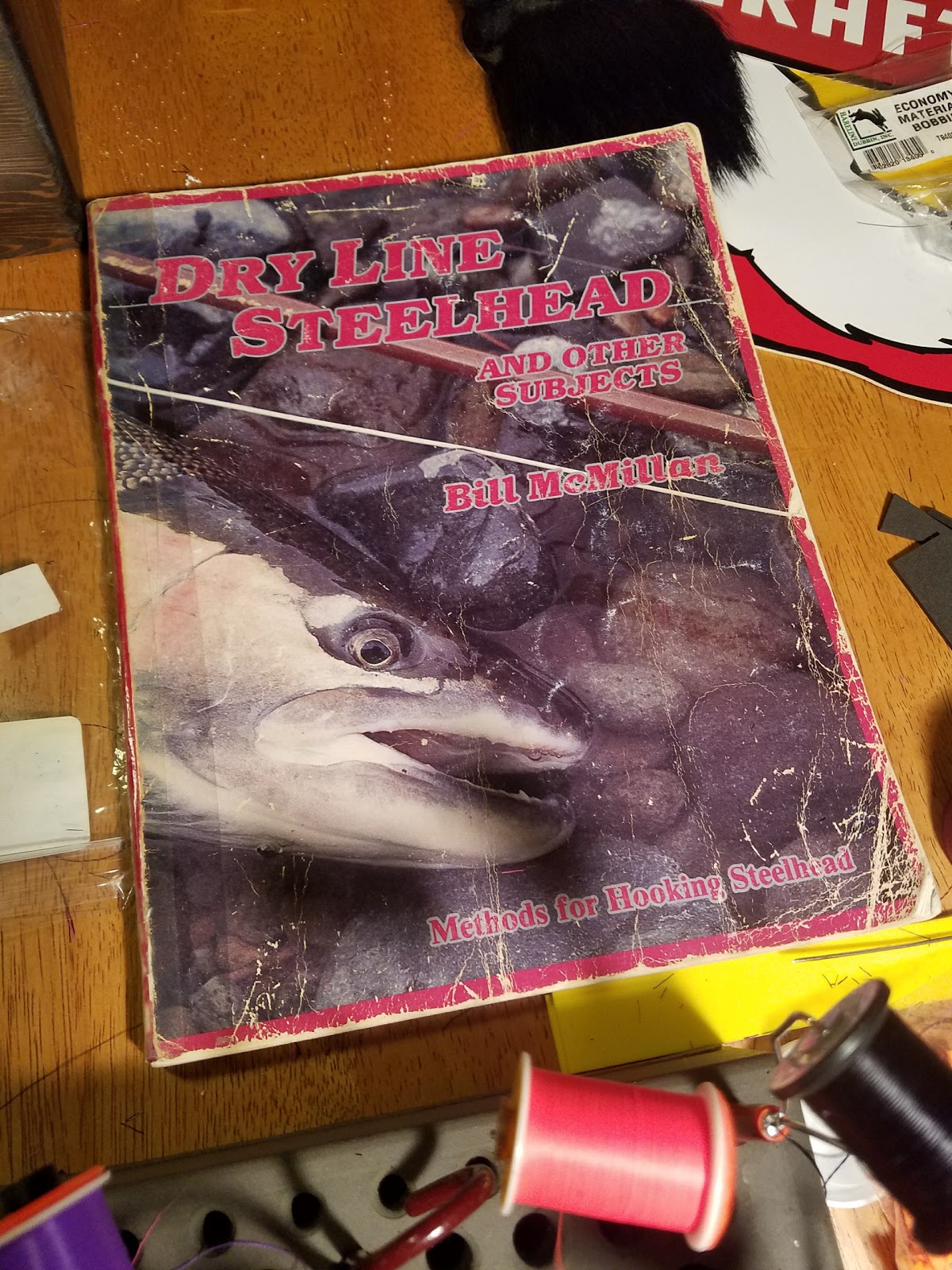
| My original battered copy of Dry Line Steelhead, held together with packing tape and binding glue. Todd Hirano photo |
The surface methods that Bill inspired form the fabric of who I have become as an angler. However, I am thankful that Bill's passion for steelhead fly fishing birthed possibly his greater passion: the protection and conservation of wild salmonids. Through those influential chapters in Dry Line Steelhead, Bill taught me about significant conservation issues. In those early years in my steelheading life, Bill's writing opened my eyes to the negative impacts of intensive hatchery management on most of our steelhead rivers. Up to that time, a steelhead was a steelhead to me, whether wild or hatchery, and I didn't realize that hatchery steelhead could be harmful to native stocks. Bill was ahead of his time when he brought this controversial information to light to the fishing public in the early 70s.
Bill has spent most of his adult life working tirelessly in scientific study in the name of protecting wild steelhead. Even though Bill retired as the president of the board of the Wild Fish Conservancy in 2011, he continued, up until just recently, to be actively involved in ongoing studies on wild salmonids, especially in the Skagit basin. He has conducted extensive spawning surveys in the local spawning tributaries near his home and the data he has compiled have been showing signs of wild steelhead recovery with the cessation of hatchery plants in the Skagit, beginning 2014. Bill has generously shared his scientific documents with me and he has kept me informed of current issues with steelhead conservation.
I owe a debt of gratitude to Bill as my fishing life is truly inspired by his writing, methods, and conservation work. My fishing style and ethics can be primarily traced to Bill as a singular source. As a result, I fish a dry line pretty exclusively. I primarily fish surface flies in the summer and fall and continue with the dry line throughout the winter and spring, using heavy irons or lightly weighted patterns.
I must extend many thanks to Bill for all he has contributed to the sport of steelhead fly fishing and for his years of conservation activism and dedicated scientific study aimed at educating fisheries managers and the public alike in the name of protecting wild steelhead. His influence has had a profound impact on me and my generation of steelhead fly fisherman and we are all better protectors and stewards of our resources because of him. Most of all, I am so thankful to have Bill as a friend and mentor who has far exceeded the visions and expectations any student of steelhead fly fishing could have - for this I am ever grateful.
![]() |
| Visiting with Bill on the Skagit beach fronting his home. Steve Turner photo. |
| Adrian Cortes raises a steelhead multiple times in a pocketwater hold and briefly hooks it on the fifth rise. Todd Hirano photo. |
Saturday, March 24, 2018
The Manic Muddler by Keith Tymchuck (Skater Of The Month - March 2018)
The idea for the Manic Muddler was born during one evening of tying with Todd, in front of a Coleman lantern, at a camp table in the Susan Creek campground on the NU. That camp table session resulted in a prototype tied with red Cactus Chenille and dyed black deer hair, material I pilfered from Todd's box. I lost the original fly first thing the next morning but the idea was set in my head. Once home, I ordered some blue and hot orange Cactus Chenille and some purple deer hair. My next efforts resulted in the pattern you see now and a blue/purple one which seemed way too gaudy and was never fished. A week later, on the first morning of my next sojourn to the NU, I tied on the orange version, promising myself that I would swing it all morning and then through the evening. About 9:30, fishing the Swamp Creek run in bright light, a spunky little hen made an aggressive grab just as the fly was nearly swung out. She took off dead down stream but soon enough she was brought to my hand. My love affair with the MM was born. The hottest NU fish I have ever had the pleasure of getting to know came to the Manic Muddler two summers ago. You had to be there, my descriptions do that amazing fish no justice. I hope you can duplicate the good luck I have had this pattern. Tail: 4 strands of hot orange Krystal Flash. Body: Silver tinsel (oval or flat) then 3 or 4 wraps of hot orange Cactus Chenille. Make sure you leave plenty of room for the deer hair which is spun on then. The head is clipped. I always fish the MM with a hitch. By the way, the flies in the photo sit atop a fly box my daughter Blair gave my for Christmas. It was custom made, with a map of the North Umpqua laser-engraved on the top. A very cool gift!
(Thanks to my good friend Keith Tymchuck for sharing this piece. Keith and I are regular fishing companions during winter and summer. Keith is also one of my fishiest friends - he somehow gets steelhead when no one else can. Keith and I met through the Speypages forum and he is a regular contributor there. Lookup him up as "Moethedog", you will see more of his fishy creations in the fly tying forum there.)
Subscribe to:
Posts (Atom)